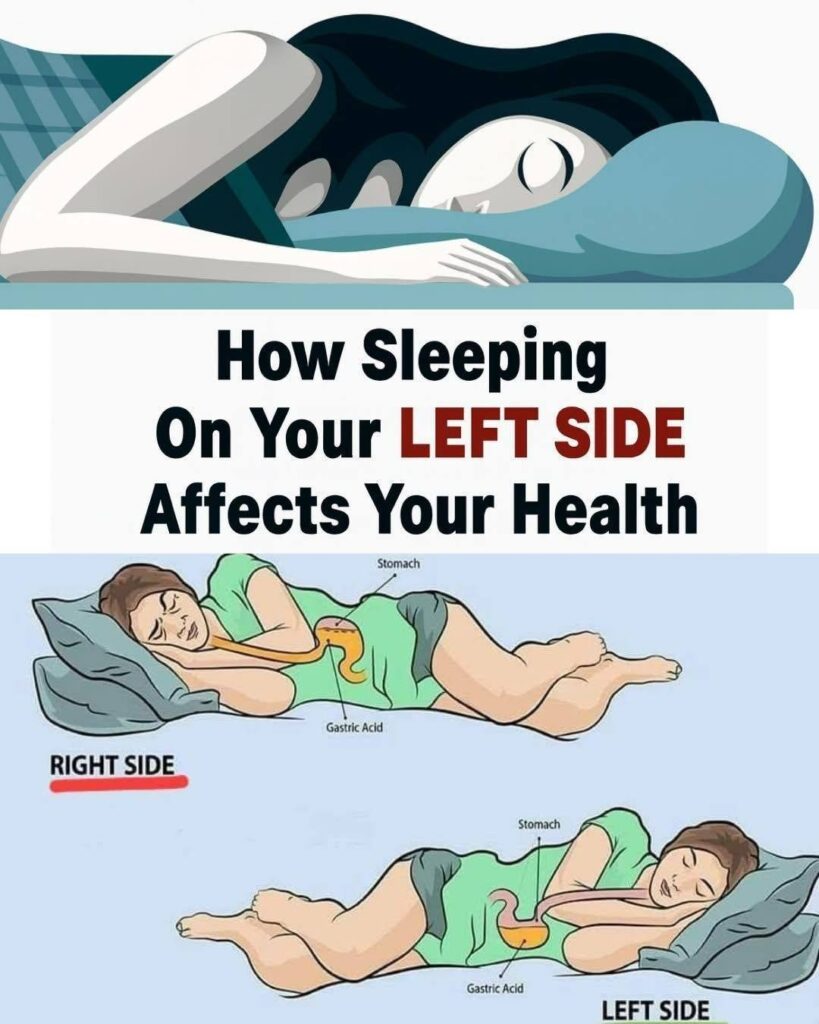
The stomach sits below the diaphragm, curving toward the left upper abdomen.
When you lie on your left side:
The junction between your esophagus and stomach (the lower esophageal sphincter) stays above the level of stomach contents
This makes it harder for acid to splash upward
In contrast, lying on the right side:
Positions the stomach higher than the esophagus
Creates a slope that encourages acid to flow back up
🔬 A 2005 study published in The American Journal of Gastroenterology found:
Participants experienced significantly less acid exposure during sleep when lying on the left side vs. the right.
💡 For many patients, this simple switch reduces nighttime heartburn — without medication.
2. Supports Natural Stomach Anatomy
The shape of the stomach follows a J-curve, with the top (fundus) on the left.
Sleeping on the left side:
Allows food and gas to move more naturally through the digestive tract
May improve gastric emptying in some individuals
While evidence is limited, many patients report feeling lighter and less bloated when they adopt this position.
3. May Aid Lymphatic Drainage
The thoracic duct — the main vessel of your lymphatic system — runs along the left side of your body.
Lying on your left side may:
Use gravity to support lymph fluid movement
Help clear metabolic waste more efficiently
🩺 Especially relevant after illness or surgery — though more research is needed.
4. Improves Pancreatic & Gallbladder Function (Theoretically)
These organs drain into the small intestine via ducts influenced by gravity.
Though not definitively proven, some experts suggest:
Left-side sleeping may reduce pressure on the pancreatic duct
Promote smoother bile release from the gallbladder
🧠 Still theoretical — but plausible based on anatomy.
⚠️ What About Other Sleep Positions?
Position
Pros
Cons
✅ Back (Supine)
Even spine support
Higher risk of snoring, apnea, and reflux
✅ Right Side
Comfortable for many
Increases acid reflux risk due to stomach positioning
✅ Stomach
Can reduce snoring
Strains neck and spine; increases abdominal pressure
✅ Fetal Position (on left)
Comfort + left-side benefits
Tucking too tightly can restrict breathing
🎯 Best overall for digestion? Left-side fetal or semi-reclined left side — especially with elevated head.
💡 Tips for Making the Switch
Changing sleep habits takes time.
Here’s how to train yourself to sleep on your left side:
Trick
Benefit
✅ Place a pillow behind your back
Prevents rolling onto right side
✅ Sleep with a body pillow
Supports alignment and comfort
✅ Elevate your head 6–8 inches
Reduces reflux even more (use a wedge pillow)
✅ Try weighted blankets
Can help maintain position
✅ Be patient
It may take weeks to adjust
🚫 Not recommended for people with certain heart conditions — consult your doctor first.
❌ Debunking the Myths
Myth
Truth
❌ “Left-side sleeping cures GERD”
False — it helps manage symptoms, but doesn’t replace treatment
❌ “Everyone should sleep on the left”
No — comfort and medical needs vary
❌ “It improves digestion instantly”
Benefits build over time — not overnight
❌ “Pregnant women should always lie on the left”
True in later pregnancy — improves blood flow to placenta
✅ Pregnant? Left side is ideal in second and third trimesters — ask your OB-GYN.
Final Thoughts
You don’t need a high-tech mattress to feel better.
But you do deserve to know how your body works — and how to work with it.
So next time you’re settling into bed…
pause.
Roll gently to your left.
Breathe deep.
Let gravity help.
Because real healing isn’t loud.
It’s quiet.
And sometimes,
it starts with one small turn — and one deeper breath.
And that kind of care?
It flows — long after the lights go out.