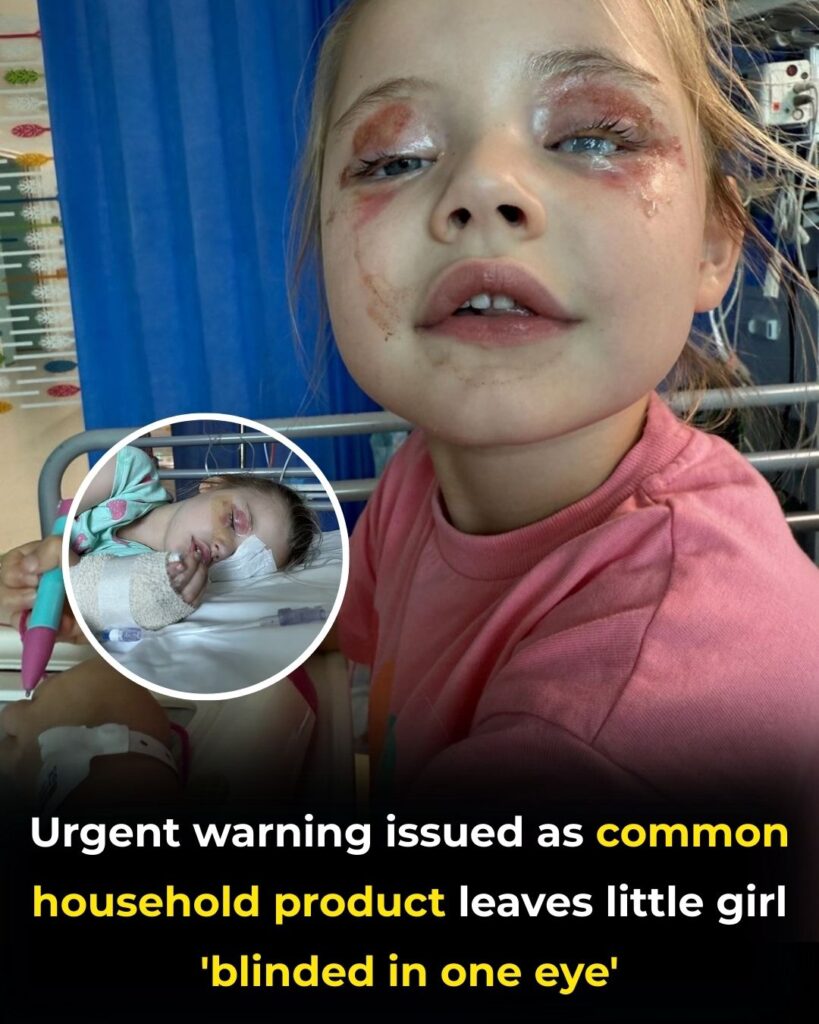
It looked like candy. Soft. Brightly colored. Squishy between small fingers.
For four-year-old Luca de Groot, that was enough.
In the quiet rhythm of a family laundry day, a single moment of diverted attention changed everything. While helping her mother, Jodi Lowe, sort clothes, Luca reached for a Persil detergent pod—its jewel-toned shell gleaming like a gummy treat. She bit down.
The pod burst instantly.
A jet of concentrated chemicals sprayed across her face. She screamed—not a startled cry, but the raw, guttural sound of searing pain. Instinct took over: she rubbed her eyes, smearing the caustic liquid deeper into delicate tissue.
Jodi’s world narrowed to one imperative: Flush. Now.
She rushed Luca into the shower, following the warning on the label—“immediately flush eyes with water and seek medical advice.” But water alone couldn’t undo what seconds had done. The burning didn’t stop. The redness deepened. The pain refused to fade.
At the hospital, doctors flushed her eyes—once, twice, three times, four. Still, the damage held fast. The concentrated surfactants and alkaline agents had already begun their corrosive work. With vision hanging in the balance, surgeons wheeled Luca into the operating room for emergency intervention—a race against time to prevent permanent blindness.
Why These Pods Are Deceptively Dangerous
Laundry pods aren’t ordinary detergent. They contain 2–3 times the concentration of cleaning agents found in liquid formulas—powerful chemicals engineered to dissolve grease and stains in cold water. To a child’s eye, that vibrant membrane looks playful. To their skin and eyes? It’s a chemical burn waiting to happen.
Safety organizations warn:
→ Just one burst pod can cause severe corneal burns
→ Skin contact triggers painful irritation within seconds
→ Inhalation of mist may inflame airways
→ The candy-like appearance exploits children’s natural curiosity
Luca was lucky. After surgery and days of anxious waiting, her vision returned. But the memory remains—a visceral reminder that danger doesn’t always look dangerous. Sometimes, it looks like a rainbow.
The Family’s Plea: A Warning Born of Trauma
Today, Jodi and her family share their story not for sympathy—but for prevention. Their message is clear and urgent:
✅ Store pods out of sight, not just out of reach—high cabinets aren’t enough. Toddlers climb. Use locked storage.
✅ Never let children “help” with laundry unsupervised—even for 10 seconds. Curiosity moves faster than caution.
✅ Teach early, teach plainly: “These are not candy. They hurt eyes. They hurt skin.”
✅ If exposure occurs: Flush eyes/skin with lukewarm water for at least 20 minutes—then call poison control (US: 1-800-222-1222) while continuing to rinse. Do not wait to see if symptoms improve.
The Hard Truth No Label Can Capture
We trust household products to be safe when used correctly. But children don’t read labels. They see color. They feel texture. They explore with mouths and hands—long before they understand consequence.
What happened to Luca wasn’t negligence. It was humanity—a mother doing laundry, a child being curious, a product designed for adult convenience wearing the disguise of a toy.
That’s the real danger: not malice, but mismatch. A world built for adults, filled with objects that whisper “touch me” to the very hands least equipped to understand the risk.
A Final Thought
Luca’s story ends with restored vision—but not restored innocence. She now flinches at brightly colored objects. She asks if things are “safe to touch.”
Her parents carry that weight. And they offer us this gift: Learn from our terror so you never have to live it.
Store the pods like medicine—because in a child’s hands, they are poison. Supervise like it’s life or death—because for a moment, it was.
And never, ever assume “it won’t happen to us.”
The pods don’t care how careful you are.
But your vigilance? That still matters.
If you have young children: Do a 60-second safety sweep tonight. Move every pod, every capsule, every brightly wrapped chemical to a locked cabinet. Not tomorrow. Tonight.