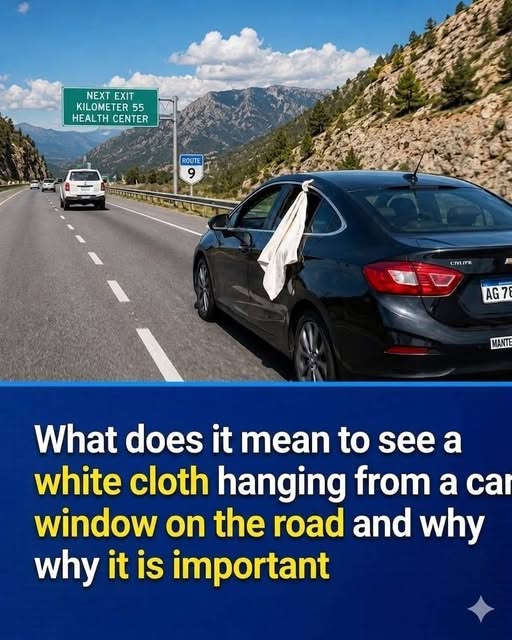
What It Really Means When You See a White Cloth Hanging From a Car Window
The Silent Roadside Signal Most Drivers Misunderstand
A white cloth flapping from a car window may seem insignificant at first glance.
But for many drivers, it instantly triggers concern.
As you pass by on a busy highway, you notice a piece of white fabric waving in the wind from a vehicle ahead. Suddenly, questions begin racing through your mind.
Is the driver experiencing a medical emergency?
Has the car broken down?
Are the passengers stranded and waiting for help?
Or is there another reason entirely?
While modern vehicles are equipped with smartphones, GPS systems, and emergency assistance features, a simple white cloth remains one of the oldest and most recognizable distress signals on the road.
Understanding what this signal means—and how to respond safely—could make a critical difference in an emergency situation.
Why Drivers Hang White Cloths From Their Vehicles
Long before cell phones existed, stranded motorists needed a simple way to communicate that they required assistance.
A white cloth, towel, shirt, handkerchief, or even a plastic bag tied to a window or antenna became a universal visual signal indicating that the vehicle was experiencing some type of problem.
In many situations, the message is straightforward:
“This vehicle is disabled, and help may be needed.”
Possible reasons include:
- Mechanical breakdowns
- Engine failure
- Flat tires
- Running out of fuel
- Battery problems
- Overheating
- Medical emergencies involving passengers
- Waiting for roadside assistance
The white cloth acts as a visible warning to other drivers and emergency personnel that something unusual has occurred.
A Signal Born Before Smartphones
Today, most drivers immediately reach for their phones when trouble strikes.
However, technology is not always available.
Dead batteries, poor reception, remote locations, and severe emergencies can leave people without reliable communication.
In these situations, a white cloth remains surprisingly effective.
Unlike hazard lights, which can drain a vehicle’s battery, a cloth remains visible for hours without requiring power.
It serves as a simple but powerful reminder that sometimes the oldest solutions remain useful even in a modern world.
Does a White Cloth Always Mean an Emergency?
Not necessarily.
While the signal is commonly associated with distress, its meaning can vary depending on location, circumstances, and local customs.
In some situations, a white cloth may indicate:
- A vehicle awaiting a tow truck
- A temporary breakdown
- A driver seeking assistance
- Participation in a convoy or organized event
- A signal to roadside service personnel
However, when seen on a lone vehicle stopped on the shoulder of a highway, it is generally safest to assume the occupants may need help.
What a White Cloth Does NOT Mean
One common misconception is that a white cloth gives a vehicle special legal status.
It does not.
A white cloth:
❌ Does not grant emergency vehicle privileges
❌ Does not allow drivers to exceed speed limits
❌ Does not authorize running red lights or stop signs
❌ Does not require other motorists to move out of the way
Unlike police, fire, or ambulance vehicles, a privately owned vehicle displaying a white cloth remains subject to all traffic laws.
The cloth is a request for awareness—not a legal command.
What Should You Do If You See One?
If you notice a vehicle displaying a white cloth, experts recommend staying calm and assessing the situation carefully.
1. Maintain a Safe Distance
Avoid making sudden lane changes or abrupt stops.
Continue driving safely while observing the situation.
2. Look for Signs of Distress
Notice whether:
- The vehicle is disabled
- Hazard lights are activated
- Occupants appear injured
- Smoke or mechanical problems are visible
3. Contact Emergency Services if Necessary
If the situation appears serious, call local emergency services.
Provide:
- Exact location
- Vehicle description
- Direction of travel (if moving)
- Observed conditions
Professional responders can evaluate the situation safely.
4. Avoid Risky Interventions
Many well-intentioned people place themselves in danger by stopping on busy highways.
Unless it is safe and appropriate to do so, allow trained emergency personnel to handle the situation.
Your safety matters too.
Why This Signal Still Matters Today
Roadways can feel impersonal.
Thousands of vehicles pass each other every day without interaction.
Yet every vehicle contains real people with families, responsibilities, and lives beyond the windshield.
A white cloth serves as a powerful reminder that emergencies can happen to anyone.
One moment, a driver is enjoying a routine commute.
The next, they may be facing:
- Vehicle failure
- A medical crisis
- Extreme weather
- A dangerous roadside situation
The simple piece of fabric becomes a visible expression of vulnerability and hope.
Hope that someone notices.
Hope that help arrives.
Hope that they are not completely alone.
Common Questions
Is hanging a white cloth from a car window legal?
In most places, yes. A white cloth is generally considered a distress indicator and does not violate traffic laws when used appropriately.
Can a white cloth indicate a medical emergency?
Yes. In some cases, drivers use white cloths to signal that someone inside the vehicle requires urgent assistance.
Should I stop to help?
Only if it is safe to do so and you feel comfortable. In many situations, contacting emergency services is the safest and most effective response.
Is this signal recognized everywhere?
While not an official international standard, the white-cloth distress signal is widely understood in many regions as an indication that a vehicle may need assistance.
Final Thoughts
The next time you see a white cloth hanging from a vehicle, remember that it is more than just a piece of fabric.
It is often a silent request for awareness.
A signal that someone may be experiencing a difficult, stressful, or even dangerous situation.
The best response is not panic.
It is calm observation, responsible action, and respect for safety.
Because sometimes the most valuable help you can provide is ensuring that the right people get there in time.
And in a world where we often pass strangers without a second thought, that small act of awareness can make all the difference.


