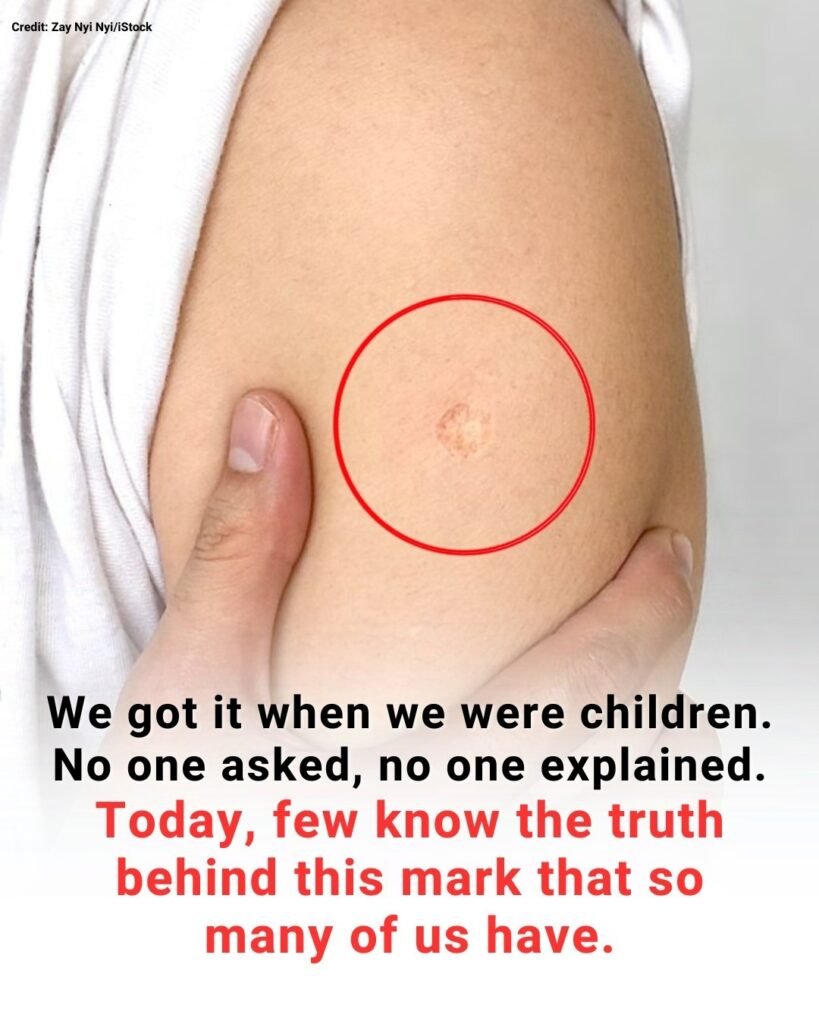
Have you ever noticed a small, perfectly round scar on someone’s upper arm—often about the size of a pencil eraser? For many adults around the world, especially those born before the early 2000s, this mark is surprisingly common. It has sparked countless theories over the years, from childhood accidents to secret medical experiments. But the real explanation is far less dramatic—and far more important.
A Mark Left by History
That round scar is most often the result of a smallpox vaccination.
Smallpox, caused by the variola virus, was once one of the deadliest diseases in human history. It killed hundreds of millions of people over the centuries and left many survivors blind or permanently scarred. The turning point came with the development of the first successful vaccine by Edward Jenner in 1796. His pioneering work laid the foundation for modern immunology.
Fast forward to the 20th century, and mass vaccination campaigns were launched worldwide. These efforts, coordinated in large part by the World Health Organization, ultimately led to one of humanity’s greatest medical achievements: in 1980, smallpox was officially declared eradicated.
Why Did the Vaccine Leave a Scar?
Unlike many modern vaccines delivered with a single injection, the smallpox vaccine used a special technique. Healthcare workers used a bifurcated needle—a tiny two-pronged instrument—to prick the skin multiple times with a live vaccinia virus (a relative of smallpox).
This process created a localized infection at the injection site. Over several days:
Why Did the Vaccine Leave a Scar?
Unlike many modern vaccines delivered with a single injection, the smallpox vaccine used a special technique. Healthcare workers used a bifurcated needle—a tiny two-pronged instrument—to prick the skin multiple times with a live vaccinia virus (a relative of smallpox).
This process created a localized infection at the injection site. Over several days:
A red bump would form.
The bump would turn into a blister filled with fluid.
The blister would scab over.
The scab would fall off, often leaving behind a round, indented scar.
The scar was actually considered a sign that the vaccine had “taken” properly. In other words, it showed that the immune system had responded as expected.
Why Don’t Younger People Have It?
Routine smallpox vaccination ended in many countries in the 1970s and 1980s as the disease was brought under control. After eradication was certified, widespread immunization was no longer necessary for the general public.
Today, smallpox vaccines are typically reserved for specific groups, such as certain laboratory workers or military personnel, in case of bioterrorism concerns. Most people born after the late 20th century were never vaccinated, which is why the distinctive scar is now far less common among younger generations.
A Badge of a Global Victory
For those who carry it, the small round scar is more than just a mark—it’s a quiet reminder of a global triumph. The eradication of smallpox remains one of the few times humanity has completely eliminated a major infectious disease.
What was once a routine childhood experience is now a historical artifact etched into skin. That small circle on the upper arm tells a powerful story: of science, cooperation, and one of the greatest public health victories in history.