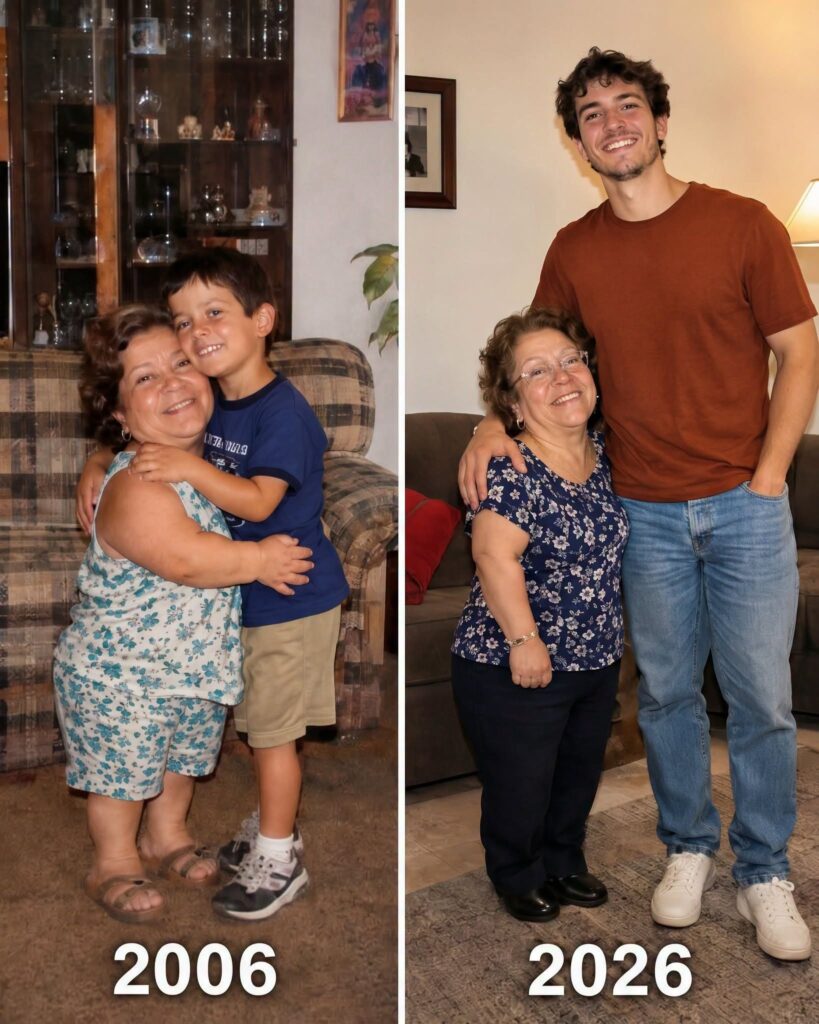
Twenty Years After My Daughter’s Death, My Grandson Discovered the Truth About Her Final Night. What the Witness Revealed Left Us Both in Tears…
It was a Thursday evening.
Elena had called me around seven o’clock.
I remembered the conversation as clearly as if it had happened yesterday.
She sounded cheerful. She told me that Mateo had been behaving wonderfully at kindergarten and that she was planning to bring him to visit me that weekend.
Before hanging up, she asked me something unusual.
“Mom, do you still have the number of that mechanic you recommended last year?”
I told her I did.
“Why? Is something wrong with your car?”
There was a brief silence.
“Nothing serious. There’s a strange noise coming from the back. I’ll have someone look at it tomorrow.”
I remembered laughing and telling her not to drive too fast in the rain.
She laughed too.
“Don’t worry, Mom. I’ll be home soon. I love you.”
Those were the last words I ever heard from my daughter.
I looked at Mateo.
“Why are you asking me about that conversation?”
He took a deep breath.
“Because Grandma, the police report says Mom’s car was damaged on the driver’s side. But the original witness statement describes something completely different.”
He opened his laptop and showed me a photograph of an old document.
It was a handwritten statement from a woman named Clara Bennett.
She had been standing outside a small roadside café on the night of Elena’s accident.
According to her statement, she had witnessed a white delivery van driving dangerously close to my daughter’s car.
Then, near the old stone bridge, the van suddenly crossed into Elena’s lane.
There was a collision.
Elena’s car spun out of control and crashed against the roadside barrier.
But the most disturbing part was what happened afterward.
The van stopped.
A man got out, walked toward Elena’s vehicle, looked inside, and then returned to his van.
Instead of calling for help, he drove away.
Clara had written down part of the registration number.
I covered my mouth.
“Are you telling me someone left your mother there?”
Mateo nodded.
“And that’s not even the worst part.”
The Woman Who Had Been Silent for Twenty Years
The following morning, Mateo took me to meet Clara.
She lived in a small house on the outskirts of town.
When she opened the door and saw us, she immediately recognized Mateo.
“You must be Elena’s little boy,” she whispered.
Mateo nodded.
Clara invited us inside.
Her living room was filled with family photographs, old books, and carefully arranged flowers.
She made us tea, but nobody touched their cups.
After a few minutes, she disappeared into another room.
When she returned, she was carrying a small cardboard box.
“I’ve kept these things for twenty years,” she said. “I always hoped someone from your family would eventually come looking.”
Inside were several newspaper clippings, handwritten notes, and a photocopy of her original statement.
There was also a small photograph of a white delivery van.
I stared at it.
“Where did you get this?”
Clara sat down.
“Three days after your daughter’s accident, a man came to my house. He told me I had misunderstood what I’d seen. He said the weather was terrible, the road was dangerous, and that I shouldn’t ruin an innocent man’s life.”
“Who was he?” Mateo asked.
Clara looked directly at him.
“He was a police officer. His name was Richard Collins.”
She explained that she had initially given her statement to the investigating officers.
But several days later, she was told that her testimony had been excluded because it was supposedly unreliable.
She was frightened.
She had two young children, and her husband had recently lost his job.
The officer made it clear that continuing to discuss the accident could create serious problems for her family.
So she remained silent.
“I’ve regretted it every day,” she whispered. “Your mother deserved better.”
Mateo reached across the table and gently took her hand.
“You were frightened. I understand.”
But Clara wasn’t finished.
She opened another envelope and removed a handwritten note.
“This is the name I discovered several years later.”
I looked down.
The name was Thomas Miller.
The Man Who Had Been Living With the Secret
Thomas Miller had owned a small transportation company in our town.
The white van had belonged to his business.
According to Clara, the man she had seen driving it was his son, Michael.
Mateo had already discovered that Michael was living in another state.
He had a family, a successful business, and two children.
For twenty years, he had lived an ordinary life.
Meanwhile, my daughter had never come home.
I felt a wave of anger unlike anything I had ever experienced.
“How could someone do this and simply continue living?”
Mateo didn’t answer.
He was looking at his phone.
A few days earlier, he had sent Michael a message explaining that he was Elena’s son and wanted to discuss the accident.
Michael had finally replied.
He had agreed to meet us.
The meeting was scheduled for the following Tuesday.
I barely slept during the days that followed.
I kept imagining the face of the man who had been driving that van.
I wondered whether he had children.
Whether he had celebrated birthdays.
Whether he had ever looked at his own family and thought about the little boy who had lost his mother because of his decision.
On Tuesday morning, Mateo and I arrived at a quiet restaurant.
Michael was already waiting.
He was in his early forties, wearing a dark jacket.
When he saw us, he stood up.
His face became pale.
“You’re Elena’s mother,” he said.
I didn’t sit down.
I looked straight into his eyes.
“Did you see my daughter that night?”
He lowered his head.
“Yes.”
My knees nearly gave way.
Mateo pulled out a chair for me.
Then Michael began speaking.
His Confession
He told us that twenty years earlier, he had been driving his father’s delivery van after attending a company gathering.
He had been drinking.
He was driving too fast on the wet road.
When he tried to overtake another vehicle, he lost control and struck Elena’s car.
He remembered seeing her vehicle spin toward the barrier.
He stopped.
He got out.
He approached her car.
And he saw her inside.
“She was still moving,” he whispered.
I felt something break inside me.
“Was she alive?”
He nodded, tears gathering in his eyes.
“I believe she was.”
“Then why didn’t you help her?”
He covered his face.
“Because I was terrified. I had been drinking. I knew I would lose everything. My father told me to leave before anyone saw me.”
I couldn’t believe what I was hearing.
He explained that his father had arrived shortly afterward, having been contacted by phone.
Together, they decided to hide the van and deny that it had been involved.
His father then contacted someone within the local police department.
The original witness statement was buried, and the investigation focused entirely on the weather conditions.
Michael’s voice began trembling.
“I told myself she was probably already dead. I told myself there was nothing I could have done.”
I stood up.
“Nothing you could have done?”
My voice was shaking.
“You saw my daughter. You knew she might still be alive. You had a telephone. You had a vehicle. You could have called for an ambulance.”
He began crying.
“I know.”
“No, you don’t know.”
I pointed toward him.
“You don’t know what it feels like to bury your child. You don’t know what it’s like to watch a four-year-old boy wait for his mother every single day. You don’t know what it’s like to keep her bedroom exactly as she left it because you cannot accept that she’s gone.”
Michael said nothing.
Then he reached into his jacket and placed another envelope on the table.
“I’ve kept this for twenty years. I think you deserve to have it.”
Inside was a photograph of Elena’s damaged car and a copy of an old repair invoice.
But there was something else.
A handwritten letter.
It was addressed to the police department and signed by Michael.
It contained a detailed confession of what had happened that night.
He had written it several years earlier but had never found the courage to send it.
“I can’t change what I did,” he whispered. “But I’m ready to tell the truth officially.”
For the first time that morning, I sat down.
I didn’t forgive him.
Not then.
Perhaps I never would.
But I wanted the truth to become part of the official record.
The Investigation Was Finally Reopened
Mateo immediately contacted the authorities.
Clara’s original statement, Michael’s confession, and the surviving business records were handed over to investigators.
The case was reopened.
Investigators also examined the old police records and discovered inconsistencies in the original investigation.
Richard Collins, the officer who had handled the case, had retired years earlier.
When questioned, he initially denied everything.
But confronted with the documents and Michael’s statement, he eventually admitted that he had been pressured to exclude the witness’s account.
He also confirmed that he had failed to investigate the white van properly.
The investigation took several months.
Eventually, Michael formally accepted responsibility for his actions, and the authorities pursued the appropriate legal proceedings.
His father’s involvement was also investigated.
The truth was finally documented.
For twenty years, our family had believed that the weather had taken Elena away.
Now we knew that another person had made a decision that changed all our lives forever.
But something else happened during those months.
Michael sent me a letter.
He didn’t ask for forgiveness.
He simply wrote:
Mrs. Elvira, I cannot imagine the pain I caused your family. I have spent twenty years trying to convince myself that leaving that night was the only thing I could have done. It wasn’t. I was selfish, cowardly, and wrong. Your daughter deserved help. I am sorry.
I folded the letter and placed it in a drawer.
I wasn’t ready to answer.
The Promise My Daughter Had Made
One Sunday afternoon, Mateo and I visited Elena’s grave.
He brought white flowers.
I brought the small birthday card she had written to me shortly before her death.
We sat together for a long time.
Eventually, Mateo spoke.
“Grandma, do you think Mom knew she wasn’t going to make it home?”
I looked at him.
“No, sweetheart. I think she was simply thinking about seeing you again.”
He lowered his head.
“I don’t remember her voice anymore.”
Those words hurt more than anything else.
I reached into my handbag and took out an old cassette tape.
It contained a recording from Elena’s twenty-eighth birthday.
We had recorded the family singing and laughing around the dinner table.
Mateo looked at me in disbelief.
“You kept this?”
“Of course I did.”
That evening, we listened to it together.
Then suddenly, her voice filled the room.
“Mom, stop recording! You’re going to embarrass me!”
We both laughed through our tears.
For a few seconds, it felt as though she were sitting beside us again.
Mateo closed his eyes.
“That’s her,” he whispered. “That’s my mom.”
I held his hand.
“Yes, sweetheart. That’s your mom.”
Twenty Years Later, We Finally Had Peace
A year passed.
The investigation had brought answers, but it couldn’t bring Elena back.
Nothing could.
However, something inside our family had changed.
Mateo no longer carried the unanswered questions that had followed him throughout his childhood.
He had learned that his mother hadn’t simply lost control of her car in a storm.
She had been struck by someone who chose to run away.
And although that truth was painful, it allowed us to stop blaming the weather, the road, or some mysterious twist of fate.
We could finally speak about what had happened without wondering whether we were missing something.
On the twentieth anniversary of Elena’s death, Mateo organized a small gathering.
Family members came.
Clara attended too.
She stood beside Elena’s photograph and placed a bouquet of white roses beneath it.
Then Mateo spoke.
“My mother died twenty years ago, but for a long time, I felt as though her story had ended with a question mark. Today, we finally know the truth. I wish she had been given the chance to come home, but I am grateful that her memory will no longer be surrounded by lies.”
I watched my grandson.
He was no longer the frightened four-year-old who had waited by the window for his mother.
He was a grown man who had found the courage to uncover something everyone else had given up searching for.
After everyone left, I returned to Elena’s bedroom.
I opened her wardrobe and touched the blue dress she had worn on her last birthday.
For twenty years, I had kept it untouched.
But that evening, I took it out, folded it carefully, and placed it in a special box alongside her photographs and letters.
I realized I no longer needed to preserve every corner of the past exactly as it had been.
I could remember my daughter without remaining trapped in the night she died.
Before going to bed, I looked at her photograph.
“Your little boy grew up, Elena,” I whispered. “And he never stopped looking for you.”
Then I smiled through my tears.
Because I finally understood something.
The truth had arrived twenty years late.
It could not restore the years we had lost, return a mother to her son, or erase the suffering caused by one terrible decision.
But it had given us something we desperately needed.
An answer.
And sometimes, even after the worst kind of loss, knowing the truth is the first step toward finding peace.
I never got my daughter back. But after twenty years of unanswered questions, I finally got her story back.
THE END.


