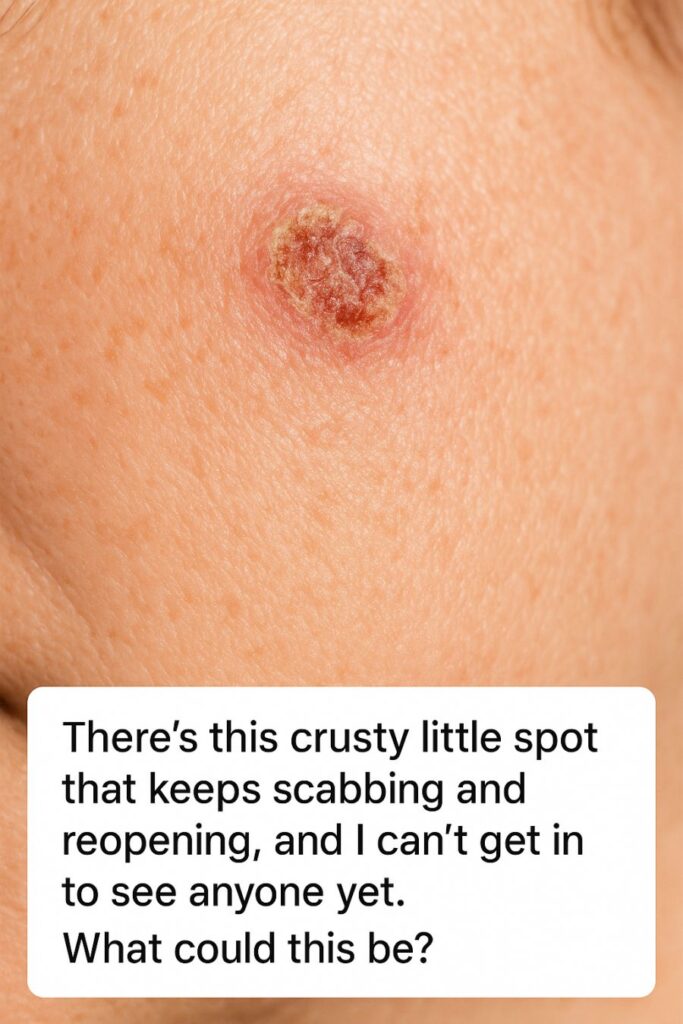
At first glance, it looks harmless—a small, rough patch on the skin that scabs over, flakes, then opens again. Maybe it bleeds slightly, then forms another crust. Weeks pass, and it’s still there. This kind of stubborn skin spot can be easy to ignore, but it’s often your body signaling that something deserves attention.
While only a medical professional can make a diagnosis, understanding what a repeatedly scabbing, non-healing spot might represent can help you decide what to do next and why it matters.
Why Some Skin Spots Keep Scabbing and Reopening
Healthy skin typically repairs itself within days. When a spot keeps breaking down instead of healing, it usually means something is interfering with the normal repair process. Common reasons include:
Ongoing irritation or friction
Sun-related skin damage
Chronic inflammation
Abnormal skin cell growth
The appearance in the image—a crusty, slightly raised lesion with redness around it—is characteristic of several conditions, some minor and others more serious.
Possible Causes of a Persistent Crusty Skin Spot
1. Actinic (Solar) Keratosis
These are rough, scaly patches caused by long-term sun exposure. They often appear on the face, ears, scalp, neck, or arms and may:
Feel sandpaper-like
Scab, flake, or peel
Return after seeming to heal
They are considered precancerous, meaning they can sometimes progress if left untreated.
2. Basal Cell Carcinoma (BCC)
This is the most common type of skin cancer and often shows up as:
A sore that won’t heal
A spot that scabs, bleeds, then reforms
A pearly or crusted bump with redness
BCC grows slowly and is highly treatable when caught early, but it should not be ignored.
3. Squamous Cell Carcinoma (SCC)
SCC may present as:
Please Head On keep on Reading (>)